Chindia
An aside on a matter of personal concern
Twenty years ago, it was common to combine China and India into a single emerging conglomeration called “Chindia.” We were the poster children of neoliberal development - growing at a fast clip, destinations for outsourced manufacturing (China) and outsourced services (India).
Chindia feels quaint, if not laughable. China is no longer emerging. It has emerged. As infrastructure goes, it is a ‘developed’ country. India, meanwhile, is stuck in a deadly combination of crony capitalism and authoritarian politics. As I write this piece, Delhi’s AQI is 279. Beijing’s is 26. A lot of India is unbreathable and unlivable in comparison to most places East of it.
Steve Jobs famously said that “Design is not just what it looks like and feels like. Design is how it works.” You could say the same about Development. It has to work. I am not a fan of high energy and material use models of growth, or a single party state for that matter, but most of the Indian elite has bought into both. They want the trains to run on time, and they want the masses to do what they are told. And self serving as they are, that elite hasn’t delivered the outcomes they themselves desire.
Take a cab from Bangalore’s airport to the city center, and you will pass hoardings of real estate developments that promise a Singapore (or Shanghai) life in your private bubble. What happens outside the gates of that bubble isn’t their concern.
The fact is, even our elites are dispensable. Our most important export - software - is getting eaten alive by AI. India, as a credible alternative to Western modernity, is a pipe dream and the culture that has replaced it is unattractive to everyone besides those who have drunk the kool-aid. Absolutely no one thinks we are a hedge against China, and any romance about the Ramakrishna-Tagore-Gandhi-Ramana alternative to muscular modernity is long gone. Instead, we have been consumed by political Hinduism, aka Hindutva, which is repulsive. Let’s not forget about caste either, which has to be annihilated. A lot of our problems are due to (mostly upper caste Hindu male) Indian elites preferring to lord it over their small pond while ignoring the ocean that’s knocking on our doors. No wonder the rupee is in free fall (breached 90/dollar while I was writing this essay).
We have self-serving elites, who would rather protect their social and economic position than to let the rising tide lift all boats: both during the license raj and post-liberalization.
Let me illustrate this claim with six points derived from this interview with Ha-Joon Chang:
We started about the same as our Confucian counterparts, but they made better investments and better choices.
We have a ‘trader’ mentality that would rather make a quick buck via finance than invest in manufacturing.
We don’t invest in the future or think in the long term: our investments in human capital development and R & D are shockingly small.
The few advantages we have are going to be swallowed by AI, which is a bigger threat to us than to most others. The same is true of climate change, but that’s a story for another day.
Our elite fights tooth and nail to keep its relative position, even if it means weakening us relative to the rest of the world.
We need to spread the wealth if we are to stand a chance.
1. We started about the same
South Korea was a very poor country until the early 60s. In 1961, India’s per capita income was $88 and South Korea’s was $94. Essentially, the same level of development.
South Korea also protected its fledgling industries:
In 1976, Hyundai produced 10,000 cars. That year, Ford produced 1.9 million cars. General Motors was approaching 4.8 million cars. Now if South Korea had free trade in cars back then, Hyundai would have disappeared overnight… This is what is called infant industry protection. They developed automobile, electronics, shipbuilding, all these industries through similar measures.
India was only superficially similar:
In India, until the 1980s, protection was used to preserve existing producers rather than giving them the space to accumulate production capabilities and go out in the bigger world to fight…That kind of protectionism doesn’t work. Protection only works when you use it to develop your own infant industries, so that they can export to the global market.
2. We want to make a quick buck
The business elites are either in the financial sector or, even if they are in the industrial sector, they still have very strong links with financial capital which doesn’t like industrialisation because, for them, the most important thing is the rate of return….Your elites do not want to wait for 10 or 15 years and sacrifice short-term financial returns to build productive capabilities.
3. We don’t invest in the future
You need to invest in worker skills, infrastructure, and research and development (R&D). I looked up the latest data on R&D in India, and as a proportion of GDP, it is barely 0.6 per cent, compared to the OECD (Organisation for Economic Co-operation and Development) average of 3 per cent, and South Korea’s 5.2 per cent.
which is why we don’t build the future:
Secondly, India has been touted as a success story of services-based development. But this strategy, when compared to what China has achieved in the last 25 years, pales into insignificance….
4. AI is going to eat our lunch
I am not one of those people who think that AI will completely change the world in the next five years…India will be one of the biggest casualties of AI. It needs to get out of there, it needs to industrialise.
5. We don’t take care of our own
Consider East Asian countries where, despite all kinds of bad things happening, military dictatorship, one party rule, repression of worker rights and everything, they sustained their growth trajectory because they shared that growth with the poorer people. All of them had land reforms and, even though they had very small welfare states, they had a lot of protection for the weak guys.
6. But we absolutely need to
So, this extensive concentration of wealth at the top in India is a huge problem…. Even if you belong to the elite, it is in your long-term self-interest to share some of your wealth with the poorer segments of the society. Because otherwise, they will destroy the system.
I can’t stress how precarious a moment this is for India. We got lucky for the first 75 years after independence. We had exceptional leadership for the first two decades, and even after Nehru’s death, the Cold War gave us maneuvering room and then, when the Soviet Union collapsed, we had our niche in Pax Americana.
None of those conditions hold anymore.
The liberal international order has collapsed and the new multipolar world is a dangerous place. One in which we have no friends or well-wishers because we are bereft of kindness ourselves. Indian social media personalities gloating over Palestinian children getting killed en masse is all you need to know about the state of our public discourse. AI is automating the few good jobs we created, though as coolies, and if that weren’t enough, climate change is going to devastate large parts of the sub-continent.
We are heading towards a civilization crisis - if not collapse - and the only thing we are capable of doing is building temples upon the ruins of mosques and calling it justice for centuries of humiliation. When a bully claims to be the victim, you know that:
truth is the real victim
you invite bigger bullies to show who is the real boss
When you don’t matter, others can choose to be patronizingly generous, or bully the fuck out of you. In today’s world, the latter is our lot. Cue the immense uptick in anti-Indian racism in the West and tariffs picked out of a hat.
Ever since the anti-colonial independence struggle, Indians have thought that they offer an alternative modernity. Dream on. Meanwhile Confucian Asia, with China at its center - is showing its fleshed out and increasingly attractive alternative. We may not like it or want to emulate it, but Indians need to introspect and change, and studying the idealized metabolite of CONFUCED societies is a necessary component of that introspection.
I am not naive in thinking China is a friend in the making; that’s unlikely to be true in my lifetime. But we can learn from our adversaries can’t we? Isn’t that what the Japanese did when Commodore Perry came knocking on their door?
I will never want to give up our diversity, our resistance to uniformity, our love of argument and metaphysical speculation, the genuine religiosity and the deep acceptance of the non-human world. But we need to open the windows of our house to the winds of the world.
The “Great Reckoning,” as Kuo calls it, demands intellectual honesty. The West must acknowledge China’s successes without dismissing them or clinging to outdated narratives that expect China to fail or conform to Western norms. The same goes for India - there’s no need to surrender our civilizational strengths, but we should learn from China’s achievements and strengthen our institutions through clear-eyed self-examination.
We have to understand both the good and the bad parts. I really like these lines from an amazing conversation between Jordan Schneider and Dan Wang:
you have four decades of astonishing growth from China, in which the country was growing at a rate of 8 or 9%. That created tremendous wealth, alleviated poverty, and made a lot of Chinese right now feel really good about what the country was able to accomplish. This is where I really want to grapple with both the good aspects as well as the bad aspects of China. Yes, it’s absolutely the case that the wealth creation here was astonishing. That has been much more impressive than what any other developing country was able to achieve — India, Indonesia, Brazil have not had the economic takeoff that China enjoyed that brought so many people out of misery and poverty.At the same time, we have more novel forms of political repression that humanity has never seen before. Both of these trends are real, and they both have to be acknowledged.
And
Xi comes off as someone who is a little too eager for groveling respect from the rest of the world, which is exactly why he’ll never get it.
Modi and Trump are cut from the same cloth, but Xi has the greatest leeway of the three to impose his whims. We will do well to understand the maximalist version of authoritarianism.
The Mood
January's intent, restated in August as mood rather than doctrine.
See Zhuangzi and Journey to the West.
TLDR; Monkey Goes East restarted as ‘Sinosophy; expect monthly essays.
There's a very famous definition of philosophy by Wilfrid Sellers, where he says that it aims ‘to understand how things in the broadest possible sense of the term hang together in the broadest possible sense of the term.’ And if you're a philosopher in this sense, you have a theory of how things in the broadest possible sense of the term hang together in the broadest possible sense of the term. That's a positive conception of philosophy, philosophy that leads to doctrines and theories and systems. Maybe Sellers’ version is closest to a system?
But there's also an alternative approach to philosophy, which makes it look more like art or poetry. It's philosophy that's channeled as a mood or as an atmosphere. And in the last couple of hundred years, that is the way moderners have often experienced non-Western philosophy. When we talk about Oriental philosophy - and I'm using that somewhat pejorative term deliberately - we often encounter it in spiritualist terms, or as a way of life, and not a specific theory of how the world hangs together.
The spiritualist-way of life label was eagerly embraced by many traditionalists themselves, who were colonial subjects demeaned and dominated by Western intellectual and scientific traditions. In response, they said: "Oh, well, those guys are better about the nature of matter, but we still have monopoly over the spiritual life, and our philosophy is way better as lived philosophy than anything these scientized and alienated westerners are offering." I don't want to get into whether this is the right way to position yourself against a dominant tradition, but I see these attempts at casting Indian or Chinese or Japanese philosophy as a way of life or a spiritual philosophy - say, in the way we consume Talks with Ramana Maharshi, I am That, or the way Alan Watts wrote as a western interpreter of East Asian traditions, or Shunryu Suzuki's Zen Mind, Beginner's Mind as an example of the East coming West - as conveying a mood or an atmosphere generated by a tradition rather than an exposition of its doctrines. The rebels against this cause were the professors - people like Bimal Matilal who wanted to teach Indian philosophy at Oxford or Harvard in the philosophy department, and that required some penance to show how rigorous and rational Indian philosophy has been over the ages.
But rigor has the stench of rigor mortis; after enormous labor, you are allowed to give a talk in some minor section of the American Philosophical Association’s annual conference, but most people don’t care. The woke have left you behind as too brahminical for the cooler parts of campus, and the philosophers reading Kripke for the 35th time weren’t going to let you teach logic to their students were they? And don’t even talk to me about those stuck making outlandish claims about spaceships and plastic surgery in the Vedas.
In contrast, the atmosphere generated by these traditions has a lot of staying power; their influence continues much after the end of decolonization. It’s now shading into Chinamaxxing as the Middle Kingdom becomes the Middle Kingdom once again. Which small town in New England or California doesn’t have a Yoga Studio? If you own an iPhone you hold an object congealed from that atmosphere. And, in that sense, the mood has traveled a lot further than any doctrine with a linear, identifiable connection to Asian philosophical traditions. Its air has seeped into homes and offices across the world.
Hypothesis: for traditions that don’t have a clear historical connection to the modern world, it’s better to evoke them as a mood or an atmosphere than as defensible theory.
All of this is to say that my reading of Chinese thinkers and traditions is going to evoke a mood (a bouquet of ‘ways’ if you will) and not make truth claims about what those philosophers, writers and texts are saying. I’m not going to read them that way at all. I’m going to read them in the way that an artist would, the way Joyce read Homer or even as how Nolan has brought Homer to our screens than how Emily Wilson has chosen to translate the Iliad or the Odyssey.
Reading Chuang Tzu creatively isn’t a license to make things up arbitrarily. Joyce was not accountable to Homeric philology, but he was ferociously accountable to something, and that something was the atmosphere of the Odyssey: the shape of a day, the way a wanderer’s mind keeps arriving in rooms he has already left. You can get a mood wrong. A person who lives inside that mood feels the wrongness immediately, even if they can’t point to the line where you went off. Suspension of disbelief is the standard I want to be held to.
The Atmosphere of Habitability
In January I called this “The Monkey Goes East.” Confucian Asia - Japan first, then South Korea and Taiwan, then China, with Singapore and Hong Kong as instructive cousins - has produced a form of modern existence that we keep describing in borrowed terms. We club Meiji with Hiroshima and then with the American security umbrella. We file China under the communist revolution and its aftermath. That carving up worked while we all lived inside the Liberal International Order and it works badly now that we don't. I wanted to look at the period from Meiji onward as though it had its own logic, its own drivers, its own principles, and to do it with the metabology I stumbled into last year while reading Machiavelli in a planetary frame.
Kaiser Kuo and Adam Tooze supplied the provocation that China is the master key to understanding the future of modernity. But these days I am a one-trick pony, and everything I think and write about has to do with the planet in some fashion. China may not be the master key to understanding Planetarity, but it’s an essential key nevertheless, and Sinosophy is the atmospheric counterpart to the analytic investigation of Habitability I restarted a couple of weeks.
Sinosophy: Planetarity with Chinese Characteristics.
The phrase is a borrowed joke, obviously. “With Chinese characteristics” is Deng’s formula for swallowing a foreign universal without asking the original owners for permission, and then daring anyone to say the result isn’t the real thing. “Socialism with Chinese characteristics.” It’s ideological metabolism: something comes in from outside, gets broken down, and comes out as fresh conceptual muscle. Planetarity is my reigning universal, and I want to see what happens when it’s digested by China.
Habitability, as I set it up a couple of weeks ago, asks three questions. Who maintains the metabolic order, across what durations, and in the face of what otherness. Those are engineering questions and I want them answered in protocols. But each of them has an atmospheric background, which is the question of what it feels like to live inside a planetary order. Sinosophy is going to work in that background.
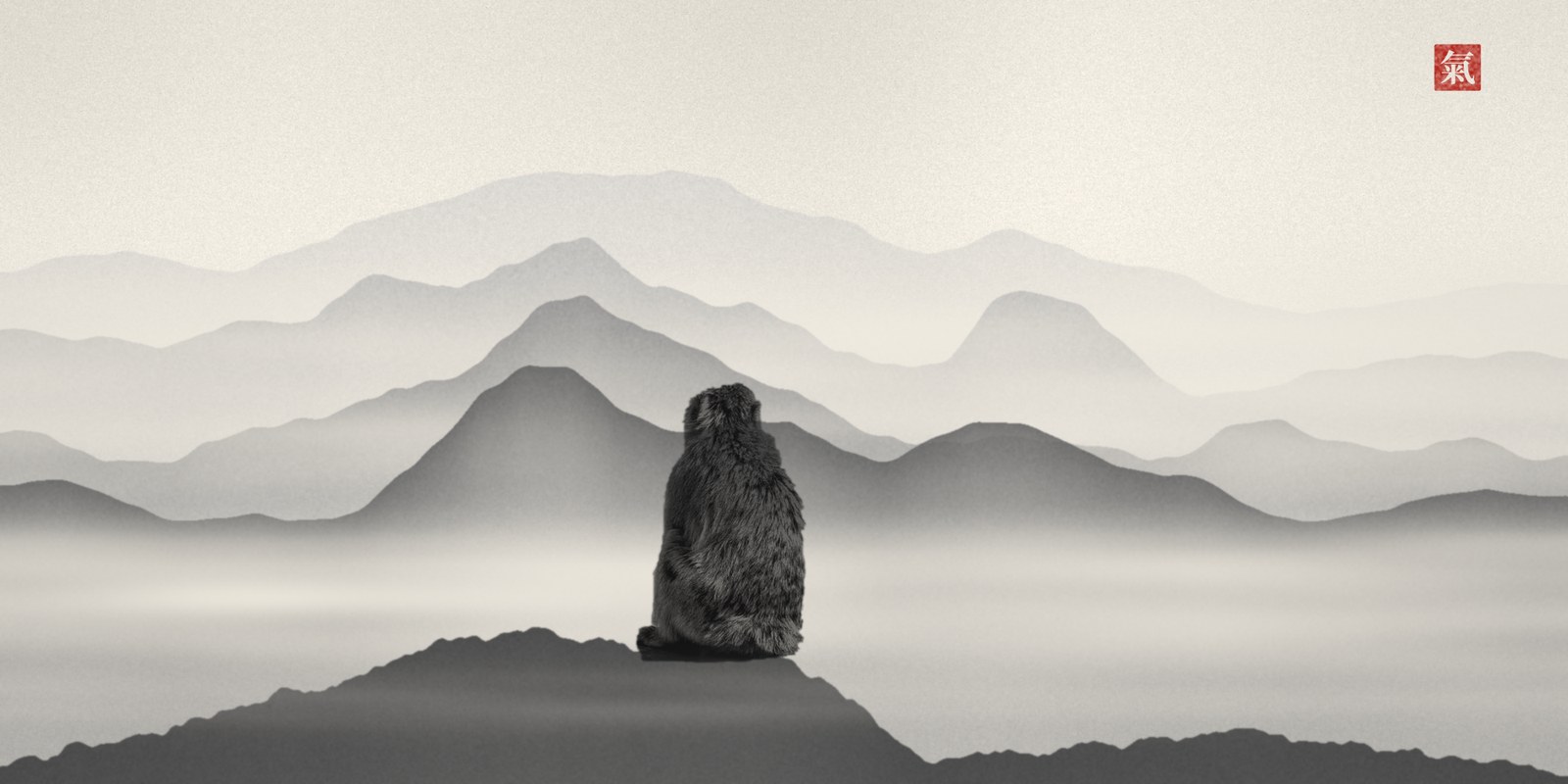
There’s an ancient precedent. Qi 氣 gets translated as vital energy, which is how it ends up in wellness brochures next to yoga mats, but the character also connotes steam, breath, air, weather. Qi is atmosphere in the literal sense before its atmosphere in the figurative one. And the vernacular art built on it, Feng Shui, wind and water, is a body of practice about where to put a house given the slope of the land, the direction the cold comes from, the way water moves and where it pools. A pattern language for habitability, roughly two thousand years older than Christopher Alexander’s (though if you read his “Timeless Way of Building,” you will see the Chinese inspiration). ‘Prana’ in Sanskrit has some of the same resonances, connecting breath, atmosphere, animality and life.
I'm not going to claim Feng Shui works, no more so than I am going to claim Vastu works or Ayurveda is better than Allopathy. I don't know whether it works and I'm not equipped to find out. I am quite fine with admitting that Ayurvedic remedies often haven't been validated in clinical trials. What interests me is that a civilization built a transmissible, quasi-technical practice whose whole subject is the habitability of a site, and built it without a concept of nature standing in contrast to a concept of society. The house, the hill, the prevailing wind and the dead ancestors sit in one system.
Journey to the West is a road story in which the road is populated by beings who are not human, sometimes demonic, and mostly indifferent to the monk’s errand. Mountains that object to being crossed. Rivers with residents. A landscape you negotiate with rather than traverse. Spivak says the planet is in the species of alterity and we inhabit it on loan. The Monkey knows that in his bones, and keeps reminding the monk about it.
The Yang of Habitability has many patterns - instruments for making a concept executable, such as the Field Note, the Institutional Prototype, the Draft Protocol and the Speculative World. The Yin of Sinosophy approaches the same problems of Governance, Time and Space, and Alterity without adding atmospheric patterns. I’m suspicious of my urge to invent them, because the moment I do, I’ve turned a mood back into a system, but I am open to the possibility that a Sisyphean task is part of the deal.
I don't know whether this atmosphere will convince; I might end up assembling a flattering mood, call it a Confucian Planetarity, and end up with a pitiful version of Chinamaxxing. The test: a person born and brought up in China should be able to read this without wincing, even while thinking I’ve got every detail wrong. Suspension of disbelief with a grimace.
Monthly, then, alternating with habitability. An essay that engineers followed by an essay that evokes. Xuanzang went west and came back with sutras that took the rest of his life to translate. I'm going the other way without the Tang emperor paying for my travels. Instead of packing sutras in my return luggage, I'll settle for a few weather reports.
Drag to move · scroll to come closer · double-click to fit